Back to Media
Questioning Your Next Move? These 10 Lessons From Tim Ferriss Can Help

11 Jan 2022
•
5 min read
Introduction
Harvard Business School is known for producing investment bankers, consultants, and corporate executives. But with entrepreneurship more in vogue than ever, a shift has taken place in its classrooms that reflects a broader rethinking of what it means to be a founder in practice. Few examples capture that change more clearly than a new case study centered on Reese Witherspoon and her media company, Hello Sunshine.
Published in October, Owning the Story: Reese Witherspoon & Hello Sunshine’s Media Flywheel (Harvard Business School Case 826-122) examines how a creative entrepreneur built a scalable, defensible business by aligning content, audience, and ownership. The case was co-authored by Harvard Business School Senior Lecturer Reza Satchu, one of the school’s influential entrepreneurial instructors who currently teaches the very popular course The Founder Mindset. The study shows how a founder – in this case, a celebrity – uses narrative control, long-term conviction, and disciplined execution to build enterprise value.
Witherspoon’s return to Harvard as a case subject and classroom participant has drawn significant interest. Hello Sunshine is being treated as a serious operating business with a repeatable model: acquire or originate intellectual property, build audience-first distribution, and retain ownership long enough for the flywheel to compound.
This week in my Founder Mindset class, we held auditions.
Witherspoon’s success mirrors the central tenets taught by Satchu. His class challenges students to rethink entrepreneurship not as a function of resources, but of commitment.
At its core, the Founder Mindset focuses on two principles:
Good judgment under uncertainty matters more than perfect information.
Full commitment to an idea, even when resources are scarce, is often the decisive factor in whether a venture survives.
These themes run directly through Witherspoon’s entrepreneurial journey. Her decision to bet early on underrepresented stories through series such as Big Little Lies and The Morning Show, to retain control rather than license everything out, and to build infrastructure before outcomes were ensured mirrors the type of judgment Satchu pushes students to practice in real time.
Her recent visit to his classroom served less as a guest lecture and more as a live illustration of the course’s central thesis: founders are made by the decisions they stand behind before success is assured. There was a heated debate in the classroom over whether she exited at the right time, with analyses suggesting the buyer, Candle Media, overpaid at a valuation of $900 million in 2021.
Satchu’s long-running effort has been to push Harvard Business School away from what he has described elsewhere as a “corporate sorting mechanism” and toward something closer to a startup incubator where students are encouraged to envision, launch, and even fund businesses before graduation. Courses like Founder Mindset and Founder Launch reflect that goal.
Witherspoon’s engagement reinforces this push. Her presence in the classroom sends a clear signal to students that entrepreneurship is not confined to technology or finance, and founders do not need permission or perfect conditions to start building.
The Reese Witherspoon case arrives at a moment when business schools are reassessing their role in shaping the economy. Questions around media, technology, ownership, and AI are increasingly central to leadership education. For students, the lesson is about agency, choosing ownership over optics, long-term value over short-term security, and judgment over convention.
For Harvard, the case exposes a cultural shift already underway within the institution. Beyond the allure of celebrity, the story of Hello Sunshine is a great example of how success is now defined, particularly in a class like Reza Satchu’s at Harvard Business School. Premier institutions like Harvard are foregrounding new and active business ventures and entrepreneurs, teaching their navigation of an always-evolving process and inviting their students to learn from moves being made today.
related articles

PODCAST
Not Born a Founder: How Brian Halligan Built HubSpot
Brian Halligan co-founded HubSpot and pioneered inbound marketing. Today, the company generates more than $3 billion in annual revenue. But before starting HubSpot, he was a sales executive who didn't have the confidence to become a founder. He wasn't born one. He learned how. This is The Founder Mindset, with Reza Satchu.
Read more

PODCAST
Proven, Better, New: Mark Pincus on Control and Betting on Yourself
Mark Pincus doesn't believe in the lightning bolt: the one brilliant idea that changes everything. He built Zynga, the social gaming giant behind FarmVille and Words With Friends, and sold it for $12.7 billion. Before that, he'd already built three companies: one sold, one went public, and one failed. He turned it all into a framework: Proven, Better, New. And a habit most founders resist: assume your idea is wrong, and test it faster than anyone else. This is The Founder Mindset with Reza Satchu.
Read more
PODCAST
Building What Outlasts Us: Demond Martin on Inclusive Capitalism
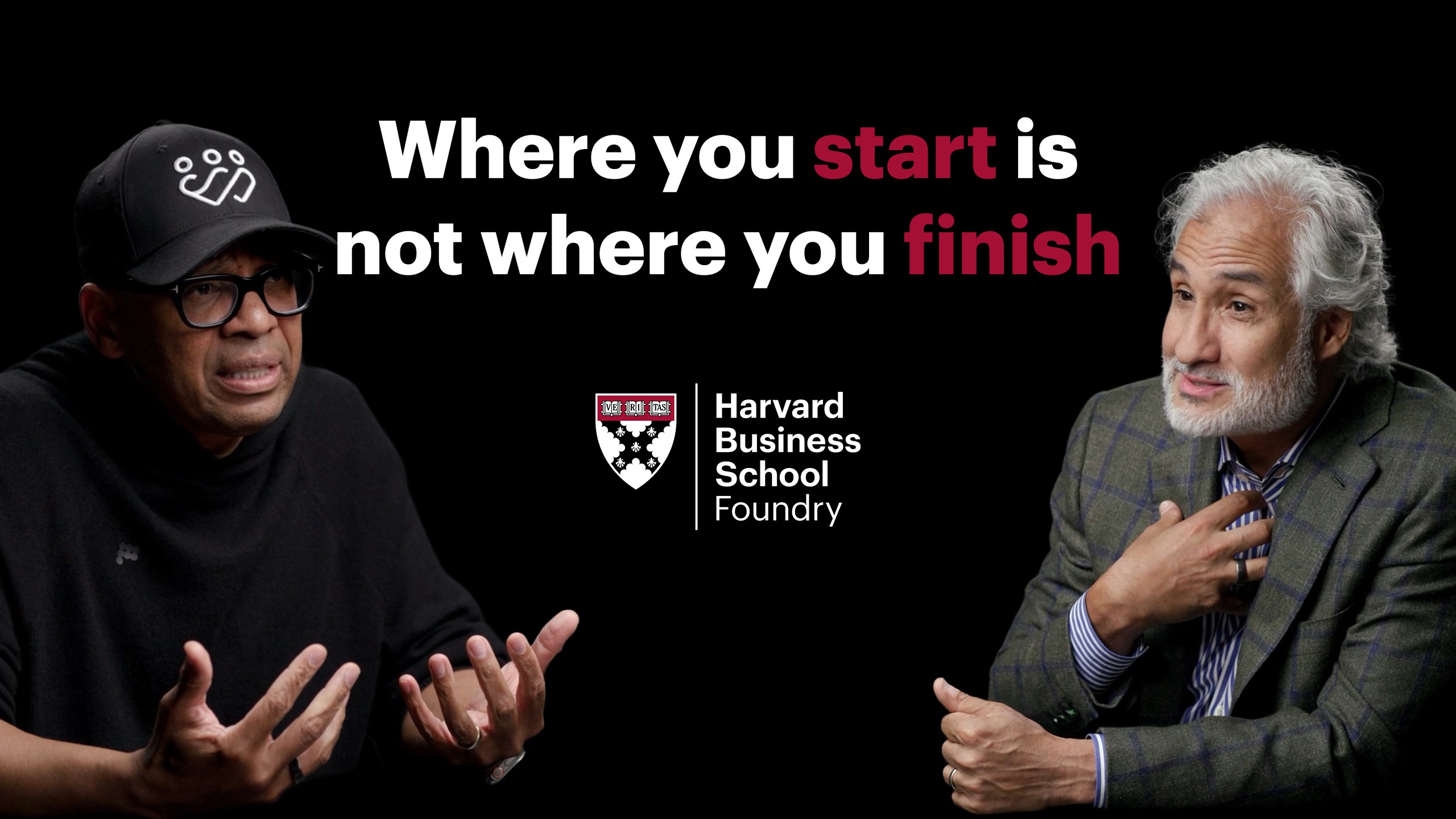
What does it take to be a founder? Demond Martin never took the obvious path. In 2022, he bet that a company could do what philanthropy alone couldn’t: close the health gap for communities like the one he came from. His company, WellWithAll, provides daily wellness products, from supplements to beverages, and gives away twenty percent of its profits, with a goal of raising $300 million for community health programs over the next decade.
Read more